Professional Asphalt Paving Services Throughout Wisconsin & Florida
Serving Madison, Baraboo, Wisconsin Dells, and surrounding communities with four generations of asphalt expertise
Call
(608) 912-3772
for your
Family-owned • Licensed & Insured • Free Estimates
Blog
Proper Asphalt Thickness for Wisconsin Climate: Complete Guide
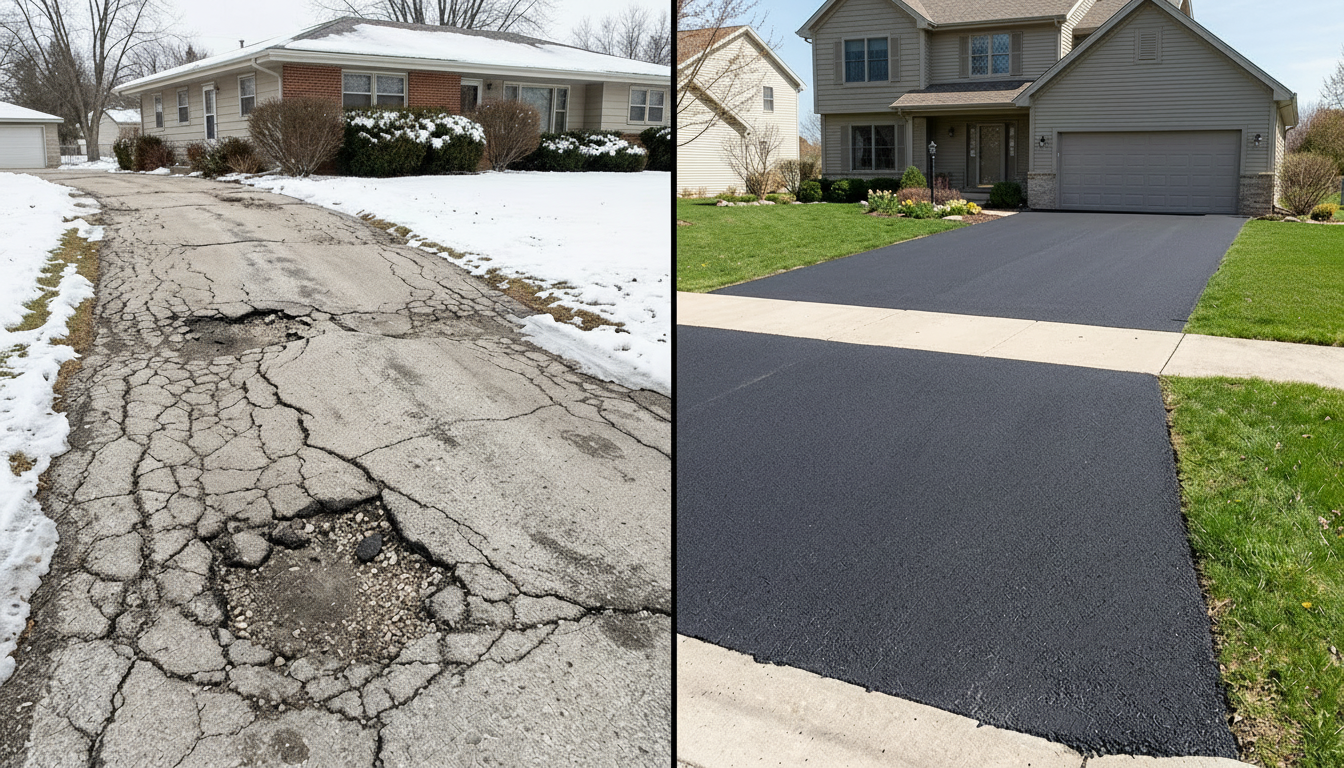
Wisconsin’s brutal winters and dramatic temperature swings create some of the most demanding conditions for asphalt pavements in the United States. From Madison’s bustling isthmus between Lake Mendota and Lake Monona to Baraboo’s tourist-heavy corridors serving Devil’s Lake State Park, proper asphalt thickness design isn’t just recommended—it’s essential for long-term pavement survival.
The humid continental climate that defines south-central Wisconsin brings freeze-thaw cycles that can destroy inadequately designed pavements within just a few seasons. Understanding how to properly design asphalt thickness for these conditions can mean the difference between a driveway that lasts 20 years and one that cracks apart in five.
Wells Asphalt Paving has been serving Madison, Baraboo, and surrounding Dane and Sauk County communities as a family-owned business, developing expertise in climate-specific pavement design that withstands Wisconsin’s harsh seasonal extremes. Owner Louie Wells and his team understand that Wisconsin’s unique climate demands specialized thickness considerations that many contractors overlook.
Why Wisconsin’s Climate Demands Special Thickness Considerations
Wisconsin’s humid continental climate zone presents unique challenges that directly impact asphalt pavement design. The state experiences temperature swings from -20°F in winter to 90°F in summer—a 110-degree range that puts enormous stress on pavement materials.
Frost Depth and Freeze-Thaw Cycles
In the Madison and Baraboo region, frost penetration typically reaches 4-5 feet deep during severe winters. This deep frost creates several critical issues for asphalt pavements. When water in the subgrade freezes, it expands with tremendous force, pushing upward against the pavement structure. More damaging still is the spring thaw, when saturated soils lose strength and can no longer adequately support traffic loads.
The freeze-thaw cycle repeats dozens of times each winter in Wisconsin. Each cycle weakens the bond between asphalt layers and creates micro-cracks that allow water infiltration. Without adequate thickness to distribute these stresses, pavements quickly develop thermal cracking, frost heaving, and premature failure.
Seasonal Load Restrictions and Spring Thaw
Wisconsin’s spring thaw period, typically March through early May, coincides with reduced load limits on many roads. During this period, saturated subgrade soils have significantly reduced bearing capacity. Pavements designed with insufficient thickness cannot adequately distribute loads during these critical weeks, leading to rutting, cracking, and structural damage that persists throughout the pavement’s life.
For commercial properties in Madison’s technology corridor or Baraboo’s tourism district, this means designing for worst-case spring conditions, not just normal summer loading. Wells Asphalt Paving has observed firsthand how inadequate thickness leads to costly spring repairs across Dane and Sauk Counties.
Residential Asphalt Thickness Standards for Wisconsin
Minimum Thickness Requirements
For Wisconsin’s climate, residential driveways require more robust design than warmer regions. While some contractors might suggest 2-inch thickness to reduce costs, this approach virtually guarantees premature failure in Wisconsin’s freeze-thaw environment.
Standard residential thickness recommendations:
3 inches minimum: Absolute minimum for light residential use with excellent subgrade conditions
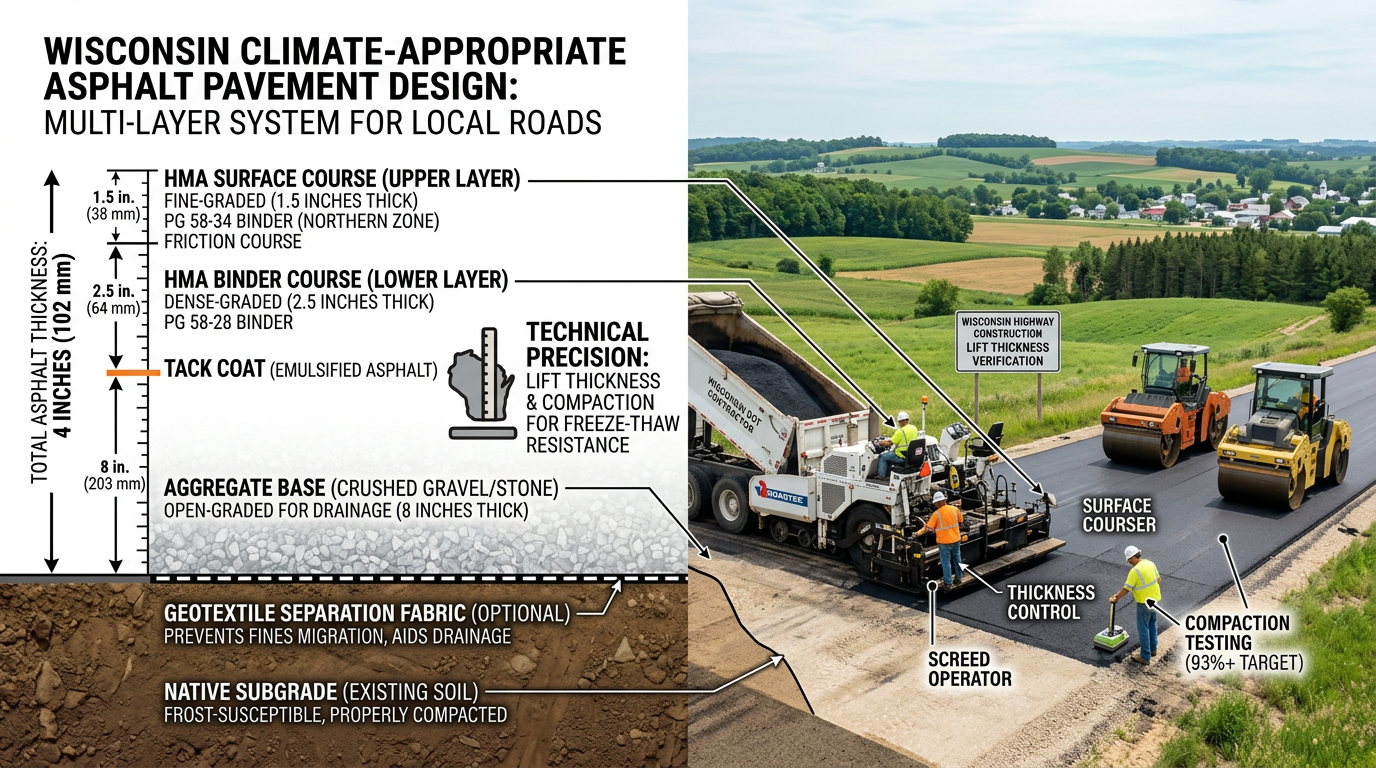
3.5-4 inches preferred: Optimal thickness for most Wisconsin residential applications
4-5 inches: Recommended for properties with RVs, boats, or work trucks
5+ inches: Required for weak subgrade conditions or heavy vehicle access
The additional cost of increasing thickness from 3 to 4 inches is minimal—typically $1-2 per square foot—but the durability improvement is substantial. A properly designed 4-inch residential driveway in Wisconsin can last 20+ years with proper maintenance, while a 2-inch installation may require replacement within 8-10 years.
Base Course Requirements
Wisconsin’s frost depth demands robust base preparation beneath the asphalt layer. The base course serves as both a load-distributing platform and a capillary break to prevent moisture migration from the subgrade.
Recommended base thickness:
6 inches minimum: Standard for most residential applications
8 inches: Preferred for areas with clay subgrade or poor drainage
10+ inches: Required for weak subgrade conditions
The base material must be properly compacted dense-graded crushed stone, not simply dumped and graded gravel. Proper compaction to 95% Standard Proctor density is essential for preventing settlement and maintaining structural integrity through freeze-thaw cycles.
Wells Asphalt Paving has seen too many driveways in Middleton and Verona fail prematurely due to inadequate base preparation. The clay soils common throughout our service area require special attention to drainage and base thickness.
Commercial Pavement Thickness Design Considerations
Commercial pavements in Wisconsin face additional challenges beyond residential applications. Madison’s state government facilities, university campus, and technology companies generate significant traffic volumes, while Baraboo’s tourism industry creates seasonal loading patterns that stress pavement structures.
Standard Commercial Thickness Guidelines
Light commercial (office buildings, medical facilities):
4-5 inches asphalt over 6-8 inches base
Designed primarily for passenger vehicles with occasional delivery trucks
Moderate commercial (retail, restaurants):
5-6 inches asphalt over 8-10 inches base
Accommodates regular delivery traffic and higher daily volumes
Heavy commercial (distribution, manufacturing):
6-8 inches asphalt over 10-12 inches base
Designed for regular truck traffic and loading dock operations
Loading Dock and Heavy-Use Areas
Areas subjected to concentrated heavy loads require special consideration. Truck loading docks, dumpster pads, and equipment storage areas experience much higher stresses than general parking areas.
For these applications, Wells Asphalt Paving typically recommends 8-10 inches of asphalt in multiple lifts, often using higher-grade binders to resist rutting and shoving under slow-moving heavy loads. We’ve successfully completed numerous heavy-duty commercial projects throughout Sun Prairie, DeForest, and the greater Madison area using these enhanced thickness specifications.
Frost Depth Impact on Pavement Structure Design
Understanding frost depth is crucial for proper pavement design in Wisconsin. The Wisconsin Department of Transportation recognizes frost depths of 48-60 inches for the Madison-Baraboo region, with some areas experiencing even deeper penetration during severe winters.
Structural Design Implications
Frost action affects pavement performance in several ways:
Frost heaving: When water in the subgrade freezes, it expands and pushes upward against the pavement. Adequate pavement thickness helps distribute these forces and prevent surface cracking.
Spring thaw weakening: During spring thaw, saturated subgrade soils lose much of their bearing capacity. Thicker pavement sections bridge over these weakened areas and prevent rutting and structural failure.
Thermal cracking: Extreme cold causes asphalt to contract and become brittle. Proper thickness provides thermal mass that moderates temperature changes and reduces thermal stress.
Subgrade Protection and Drainage
Effective pavement design must address moisture management to minimize frost action. This includes proper subgrade preparation, adequate base thickness to serve as a capillary break, and surface drainage to prevent water infiltration.
In areas with clay subgrade—common throughout Dane and Sauk Counties—additional base thickness and improved drainage become even more critical. Clay soils are particularly susceptible to frost action and lose significant strength when saturated.
Wells Asphalt Paving has extensive experience working with the challenging clay soils found throughout Stoughton, Oregon, and Mount Horeb. Our thickness recommendations account for these local soil conditions to ensure long-term pavement performance.
Material Selection and Seasonal Construction Factors
Wisconsin’s short construction season demands careful attention to material selection and construction timing. The optimal paving window typically runs from late April through October, with the best conditions occurring during warm, dry periods in late spring and early fall.
Climate-Appropriate Mix Design
Asphalt mixes for Wisconsin must be designed to resist both high-temperature rutting during summer heat and low-temperature cracking during winter cold. This typically requires:
PG 64-28 binder: Standard grade for most Wisconsin applications
PG 70-28 binder: For heavy traffic or high-stress areas
Proper aggregate gradation: Dense-graded mixes that compact well and resist moisture infiltration
Construction Season Limitations
Wisconsin’s construction season constraints mean that proper thickness becomes even more critical. There’s limited opportunity for repairs or reconstruction, so getting the design right the first time is essential.
Wells Asphalt Paving schedules thickness-critical projects during optimal weather windows, typically May through September, when ambient temperatures support proper compaction and curing. Our experience serving communities from Wisconsin Dells to Janesville has taught us the importance of timing major paving projects to coincide with favorable weather conditions.
Local Considerations for Madison and Baraboo Areas
Madison-Specific Challenges
Madison’s unique isthmus geography between Lake Mendota and Lake Monona creates specific drainage challenges that affect pavement thickness requirements. The proximity to large water bodies moderates temperature swings but can increase humidity and frost action in certain areas.
The heavy traffic volumes on Madison’s arterial roads, combined with the stop-and-go patterns around the University of Wisconsin campus, create additional stress on pavement structures. Commercial properties in the technology corridor require thickness designs that account for both climate factors and heavy traffic loading.
Baraboo Area Considerations
Baraboo’s tourism industry creates unique seasonal loading patterns, with heavy RV and trailer traffic during summer months to Devil’s Lake State Park and the Wisconsin Dells area. This seasonal variation requires thickness designs that can handle both light winter loading and heavy summer tourist traffic.
The rolling terrain common in Sauk County also affects drainage patterns and frost penetration, requiring site-specific thickness adjustments based on slope, aspect, and local drainage conditions.
Cost-Benefit Analysis of Proper Thickness
While increasing asphalt thickness adds upfront cost, the long-term benefits far outweigh the initial investment. Consider these factors:
Upfront Cost Increase: Adding 1 inch of thickness typically costs $1.50-$2.50 per square foot
Longevity Improvement: Proper thickness can double pavement life from 10-12 years to 20-25 years
Maintenance Reduction: Thicker pavements require less frequent crack sealing and patching
Replacement Avoidance: Adequate thickness prevents premature reconstruction costs
For a typical 1,000 square foot driveway, the additional cost of increasing from 3 to 4 inches might be $1,500-$2,500. However, this investment can prevent a $15,000-$20,000 replacement project 10-15 years earlier than necessary.
Professional Design and Installation
Proper asphalt thickness design requires understanding local soil conditions, traffic patterns, drainage characteristics, and climate factors. While general guidelines provide a starting point, site-specific conditions often require adjustments to standard recommendations.
Wells Asphalt Paving provides comprehensive site evaluation and thickness design services for both residential and commercial projects. Our team evaluates subgrade conditions, drainage patterns, expected traffic loading, and local climate factors to develop optimal thickness specifications for each project.
We serve the entire south-central Wisconsin region, including Madison, Baraboo, Middleton, Sun Prairie, Verona, Oregon, Stoughton, Mount Horeb, Wisconsin Dells, Portage, Janesville, and all surrounding communities. Our local expertise ensures that your pavement thickness design accounts for the specific challenges of Wisconsin’s climate and your site’s unique conditions.
Proper asphalt thickness design for Wisconsin’s climate requires understanding the unique challenges posed by deep frost penetration, freeze-thaw cycles, and seasonal load variations. From Madison’s urban corridors to Baraboo’s tourism routes, inadequate thickness is the leading cause of premature pavement failure in our region.
Wells Asphalt Paving’s extensive experience serving Dane and Sauk Counties has taught us that investing in proper thickness design pays dividends in pavement longevity and reduced maintenance costs. Whether you’re planning a residential driveway in Cross Plains or a commercial parking lot in Reedsburg, we provide climate-specific design expertise that ensures your pavement investment withstands Wisconsin’s challenging conditions.
Don’t let inadequate thickness design compromise your pavement investment. The difference between a 15-year pavement and a 25-year pavement often comes down to just one additional inch of properly designed asphalt thickness.
Ready to ensure your pavement project is built to last? Contact Wells Asphalt Paving today for expert thickness design consultation. We provide detailed site evaluation, climate-specific recommendations, and professional installation throughout south-central Wisconsin. Call us (608) 912-3772 or visit our website at wellsasphaltpaving.com to schedule your free consultation and learn how proper thickness design can protect your investment for decades to come.

Quality Asphalt Paving Backed by Four Generations of Wisconsin Experience
Since 1978, Wells Asphalt Paving has been Wisconsin's trusted choice for professional asphalt paving services
608-912-3772
Request a Quote
Wells Asphalt Paving
Another Job Wells Done!
Proudly serving Wisconsin since 1978 with locations in Madison and Baraboo
CONTACT US
608-912-3772
Madison Location: 6666 Odana Rd #163, Madison, WI 53719
Baraboo Location: Box 424, Baraboo, WI 53913
HOURS
Mon - Sun 7:00 am - 5:00 pm
Social Media